Showing posts with label Anna Hazare. Show all posts

Monday, March 11, 2013

Teekhi Baat with Anna Hazare/IBN7/ March 09, 2013


We will not support people who contest elections’


Noted social reformer and anti-corruption activist Anna Hazare speaks to IBN7 on Kiran Bedi, Arvind Kejriwal, his new andolan Janatantra Morcha and a slew of other issues during Teekhi Baat  Excerpts:
Didn’t you say that you don’t agree with this Lokpal Bill which is to come now?
Yes, the Bill is not right. A Lokpal bill should end corruption and poor people must get justice.
You don’t accept it.
Certainly not.
Your associate Kiran Bedi says that she agreed with the Bill.
Kiranji said the Bill is good after reading the content of the Select Committee Report. But the decision that the Cabinet took after Select Committee that they will not include class one, two, three and four is wrong. These officials are connected with the poor people and their issues.


But Kiran Bedi has not changed her statement since then.
She said later that she did not know this. Now Kiranji is not saying that the Bill is 100 per cent correct.
Arvind got into politics, formed Aam Aadmi Party. He was an honest officer who worked with you. Is his decision to get into politics the only reason for his split with you, or is there some other reason too?
This is the only reason. He wanted to take the path of politics and I do not like it. Because I believe that the difference that an ‘andolan’ can make cannot be brought about by any political party. Today 65 years after Independence, we can say that we got it due to ‘andolan.’
Are you giving a new look to the protest?
It is a struggle and hence we are giving it a new look.
What name would it have?
Janatantra Morcha. It will not fight any elections or form a political party. Its main objective would be struggle.
If Kiran Bedi from you team contests elections, what would you do?
We will not support people who contest elections.
If Kiran contests elections, you will not keep any relations with her.
We will not extend support to her. We will have no relations with her.
Hence, people with you will not join any party.
People, who join any party, will not be with us.

Monday, July 30, 2012

Anna must go ...Power & Politics / The Sunday Standard/ July 29, 2012

Where’s the party? Anna must go beyond protests to be the change


Dear Shri Annaji,

You have become a symbol of clean politics. Your team is fighting a selfless battle for change. You got a standing ovation from the young and the old, the rich and the poor, from teens, men and women cutting across class and community. When you chose to fast, your admirers gave up even water in sympatico. When you suffered internal agony, they fought the summer heat and power-hungry politicians. Your simplicity, frugality, transparent exterior and interior, and the resolve to teach a lesson to the tainted establishment through democratic means made you a soft target. People saw Jayaprakash Narayan in you.


Like you, JP also emerged from nowhere and captured the imagination of the masses that had lost faith in the political order of the day. You are, likewise, expected to dominate the political discourse and not become a part of it by joining government panels and sending emissaries to parley with scheming political satraps. You thought writing letters would have the desired effect on those who are used to feeding them to shredding machines or put away in files. Masters at their game, they outsmarted you and your team. Even those Opposition leaders you trusted double-crossed you and your mission. While JP aimed to replace the existing political charter with his own, your team chose to work through the system. You have also opted for a hi-tech, choreographed agitational approach by hosting fasts at urban venues which get you immediate eyeballs. But the crowds are thinning. This doesn’t mean they have lost faith in you; it only indicates the success of the political class in isolating your group. They don’t want any outsider to capture their space. JP did, by becoming one of them.

The difference between you and the Lok Nayak ends there. JP took the politicians into confidence. He took over their leadership and directed and dictated them to follow his line. Unfortunately, you committed the cardinal error of trusting the ruling dispensation. Many of your staunch supporters feel that some of your key confidantes were keen to share the high table with senior ministers. While their motives were never suspected, their methods proved disastrous as the might of the government roundly defeated and derailed your movement. You were promised a clean and powerful Lokpal Bill so that you would turn down the heat. But they unleashed vicious propaganda against your team members. Stung by the filthy campaign, your team decided to influence the outcome of elections in state Assemblies but met with little success. JP was able to throw the ruling party out of power in 1977. The mighty Indira Gandhi and her son Sanjay lost the elections.

Now you are being accused of playing politics. As your team relentlessly pursues its agenda, it has chosen to attack all political parties with which it had previously opened dialogues. Since your commitment to provide a clean alternative to the current tainted system is never in doubt, it would be better for you to float your own political party and provide an alternative agenda.

In 1987, V P Singh floated his own political party on the anti-corruption plank and defeated the ruling Congress to become prime minister. It is time for transition: Anna the social activist must become Anna the politician. I know your team and you have already announced that none of you are looking for a government post. This would perhaps give you the popular mandate to implement your vision. You have the resources. You have the middle and lower middle classes following you blindly. You possess a team that has seen the system from within. Even if most of your aides belong to the urban elite, they can mobilise others. Don’t forget that Team Anna, including you, has the largest following among Netizens who dominate the mindspace of young India. A cursory Google search reveals that you have 46 million page views as against 36 million for the Prime Minister; 21 million for Sonia Gandhi; 36 million for Narendra Modi and just 20 lakh for L K Advani. Surprisingly, websurfers are more interested in your mission than in rich entertainers like Amitabh Bachchan (43 million), Priyanka Chopra (39 million) and Shah Rukh Khan (32 million). Combined with your followers on Twitter, you enjoy more cyber-support than the entire political leadership put together.

Indians are worshippers by birth. But they worship only those who defeat evil. For you, all political parties are foes of the people. The only option left for you is to prove that you represent the masses who have lost confidence in politicians. You have to shun the occasional flirtation with the enemy. In an age where image defines character, you sport the right look—the knight in shining white khadi, Gandhi topi and guileless smile.

Annaji, you have engaged the powers-that-be in both open and secret dialogue but they just don’t bother. They have now challenged your acceptability by asking you to contest an election. Take them head-on. You can’t continue to dictate your agenda to those who have, rightly or wrongly, got the public mandate. Baba Ramdev and you symbolise the inclusive nature of Indian society: a combination of white and saffron, urban and rural, and khas and aam aadmi could be a surefire winner in an election.

prabhuchawla@newindianexpress.com; Follow me on Twitter @PrabhuChawla

Monday, December 26, 2011

Power & Politics/ The Sunday Standard/ December 25, 2011

Power & Politics

The King C0ng Option is on the Table, and It's Not Going To Work

Consistency has never been the virtue of Indian political parties. The ruling Congress is no exception. Mauled and marred by adverse publicity for its failure to create a strong Lokpal Bill, the Congress first chose to walk with Team Anna. It accepted the deadline set by Hazare for the Bill’s passage. It made Team Anna’s voice mightier than its own collective speech. Leaders, including Sonia Gandhi and Manmohan Singh, provided mass legitimacy to the movement by writing numerous letters to Anna. But that was a couple of months ago.

Last week, the same Congress party questioned the very idea of civil society activism. Suddenly, it invoked the principle of parliamentary supremacy and asserted its right to legislate, even if it went against the spirit of the Constitution. Through various actions and statements, the party leadership is trying to create the impression that it is not merely hanging on in office, but also has the will to govern with full authority. It is not willing to lose sleep or prestige under pressure from an agitation led by an ‘individual’. The Congress has once again asserted its unique DNA, which allows it to make and break deals according to its convenience, even at the cost of conviction.

The Congress has decided to confront its challengers within and outside. None other than the Congress president herself blew the bugle. While addressing partymen, Sonia scolded them for behaving like losers. She repeated her mother-in-law Indira Gandhi’s favourite ideological weapon — the destabilisation theory. She said: “Let’s fight the forces out to destabilise us; the forces who never accepted the verdicts of 2004 and 2009.” She went a step further by announcing, “I am always ready for a fight.” The party, as well as UPA ministers looking forward to their Christmas holidays were once again ordered to train their guns on the Opposition. During the Lokpal debate, Sonia thumped her desk vigorously when Lalu Prasad Yadav made fun of Team Anna. The Congress was once again at its usual best: dividing the Opposition and isolating its worst enemy, the BJP. Even Finance Minister Pranab Mukherjee took an uncharacteristically confrontationist approach when he dismissed important objections raised by the Leader of the Opposition Sushma Swaraj on the Lokpal Bill. Mukherjee argued that Parliament cannot give up its right to legislate simply because the judiciary may strike it down. Interpretation: Parliament could also pass laws that can take away the fundamental rights of citizens as it happened during the Emergency. After Sonia and Pranab became aggressive, Manmohan couldn’t afford to be left behind. During a meeting with corporate leaders last week, the Prime Minister chastised them for attacking the Government for policy paralysis. Even top industrialists like Ratan Tata must have been shocked at Manmohan’s newly acquired confidence. He left none of them in doubt that the Government wouldn’t treat them as partners in growth if they continued their pessimistic attitude.

He couldn’t have spoken like a maverick in the House, unless he was assured the full support of various political parties. For the first time after many months, the Congress was able to divide the entire Opposition in the name of the minorities. One could notice a sense of relief on the once-sullen faces of Congress leaders when the composition of the Lokpal, and not its contents and powers, became the subject of national debate. By adopting the British policy of divide and rule, the Congress changed the discourse on corruption. Barring the BJP, all parties who were earlier pleading for a strong Lokpal suddenly chose to support and laud the Government on the clause providing for not less than 50 per cent reservation for SCs, STs, OBC, minorities and women in the Lokpal bodies. They must have forgotten to read the Bill, which is an apology of a legislation. If passed in its current form, the Lokpal wouldn’t have any powers to investigate or prosecute and will be just one of the many commissions or panels that occupy over 100 offices in the capital and whose members enjoy all the perks of a Cabinet minister, but not the authority to advise even a ministry official. Obviously, the Congress and its allies have come to the conclusion that corruption isn’t an election issue in India. Recent by-election results in Bellary and other places delivered verdicts in favour of those who are symbols of corruption in high places. According to Congress insiders, the party is confident of scoring impressive victories in all the five states going to the polls in early 2012. For the Congress, winning an election by any means symbolises political acceptability. In the process, it is betraying the most powerful and innovative slogan Indira gave the nation in 1980: “Elect a government that governs.” prabhuchawla@newindianexpress.com

Monday, August 29, 2011

Race Course Road/ The Sunday Standard/August 28, 2011


PM’s Crisis Managers Lack Political Skills

The success of a leader depends on the team he chooses. His effectiveness also lies in trusting some who may have been part of his predecessor’s kitchen cabinet. If Prime Minister Manmohan Singh is passing through an agonising phase, it’s because he ignored those who possess formidable skills in political manoeuvering and negotiation. Many senior Congress leaders feel that by drafting in his team only those who haven’t handled political crises in the past to deal with Crisis Anna, the Prime Minister walked into a trap laid by civil society leaders and the Opposition. Some feel that those who were once associated with Indira Gandhi and Rajiv Gandhi have been kept out. While they admire both the commitment and talents of the negotiators led by Finance Minister Pranab Mukherjee, Congressmen also argue that involving experienced persons would have yielded better results. For the past few months, a high power group comprising Mukherjee, Home Minister P Chidambaram, Law Minister Salman Khurshid, Human Resources Minister Kapil Sibal and Parliamentary Affairs Minister Pawan Bansal have been dealing with various political catastrophes, including the Anna Hazare and Baba Ramdev agitations. The team is adept at legalese and procedure, but none among them has the necessary experience to deal with complex, relentless social activism. For Team Pranab, excessive use of authority, instead of dialogue, or invoking statutes appears to be the best tool to defeat dissent. Even Manmohan has no experience in handling powerful social or political agitations. Congress insiders are wondering why ministers and leaders like Ghulam Nabi Azad, Kamal Nath, Anand Sharma, Veerappa Moily, Bhupinder Singh Hooda, Ambika Soni et al were kept out of the negotiating team. All of them are known as champions of political wrestling. They possess enough talent to tire their opponents out, and do whatever it takes to break the opposition. Both Indira and Rajiv used them to handle difficult political situations in various states as well as at the Centre. They may have got ministerial berths in Manmohan’s Cabinet, but the Prime Minister seems to be more comfortable with those who carry no past baggage.

Sonia’s Civil Society Allies Ignored

If the Government left out political leaders from the Indira-Rajiv era from the mainstream dialogue with Anna, even the few VIP civil society leaders associated with Congress President Sonia Gandhi have also become irrelevant. Some of them are members of the powerful National Advisory Council. They have always been part of the Government’s consultative process for formulating any new legislation. But when Sonia fell sick and left for a surgery abroad, the Government didn’t involve even highly vocal NAC members like Aruna Roy and Harsh Mander in the process of finalising the Lokpal Bill. Finally, Roy had to submit her version of the Bill to the Standing Committee for consideration, forcing the Prime Minister to include her speech in his proposal as well. In the absence of a direct invitation from the Prime Minister or the Government, Mander and Roy are actively participating in TV debates and pushing their own variants of the Lokpal Bill.

Manmohan’s Governor Surprise

Even as the entire nation was discussing the Lokpal Bill, the Government sprang a surprise by appointing 78-year-old K Rosaiah as the Tamil Nadu governor. The former Andhra Pradesh chief minisiter was charged by the state Anti-corruption Bureau in March for passing an order regularising occupation of prime land worth over Rs 200 crore. The Centre delayed his appointment till the court acquitted him. However, an appeal has been filed against the lower court’s order. Rosaiah is one of the four new governors appointed; two others were merely shifted from one state to another. Another surprising feature of these gubernatorial appointments is the preference given to antiquated politicians. Both Ram Naresh Yadav, a former Uttar Pradesh chief minister, and Vakkom Purushothaman, a former speaker of the Kerala Assembly, are in their mid-eighties. But the Prime Minister seems to have learned some lessons from the conduct of Hans Raj Bhardwaj, the governor of Karnataka. Manmohan has chosen as governors only those Congressmen who do not have a reputation for confrontationist posturing. Purushothaman, Yadav and Rosaiah are known for their objectivity and genteel behaviour. Even MOH Farook, the new Kerala governor, has always avoided confrontation with chief ministers. Rosaiah and Yadav have been sent to states ruled by non-Congress governments like Tamil Nadu and Madhya Pradesh. According to top government officials, the Prime Minister was under pressure to appoint aggressive Congress leaders in various Raj Bhavans, but he resisted. He, however, agreed to move Farook to Kerala, which is now ruled by the Congress. It’s obvious that these appointments didn’t reflect the hand of Congress President Sonia Gandhi.

Ministers Make Their Own Drafts

Anna Hazare has not only made duly elected representatives irrelevant, his movement has also made the steel frame of the Indian civil services dispensable. For the first time, the political class took over the function of formulating laws and legislation. Normally, the Cabinet Secretariat and its senior officials are involved in drafting legislation, along with the officers of the concerned ministry. But this time round, the ministers themselves decided to do the job. Various drafts were circulated, written by politicians; these reflected their politics, instead of being feasible or legally robust. The newly appointed Cabinet Secretary was, in fact, learning about the contents of the proposed laws from television debates. Ministers and interlocutors were so confident of their skills that they even kept the officials from the Ministry of Parliamentary Affairs and the Law Ministry at bay. Only the private secretaries of the concerned ministers were trusted. But civil servants are having the last laugh as none of the drafts have cut any ice till now.

Monday, August 22, 2011

Power & Politics / The Sunday Standard Magazine/ August 21, 2011


No Government, Lost Opposition, but Mera Bharat Mahan

It may sound a trifle absurd, but the person who coined the slogan ‘Mera Bharat Mahaan’ deserves a Noble prize for fiction. For the past few months, each and every institution of good governance has been systematically demolished. The legitimate authority of the state has been compromised. The credibility of the Prime Minister has been eroded, and his personal integrity has come under political scrutiny. The opposition has failed miserably to offer alternative leadership or a credible agenda. Yet, this nation of 1.2 billion people hasn’t lost its collective sanity. Betrayed by the leaders it elected and let down by the institutions it created, Bharat is battling with two crises: non-governance and an isolated leadership. The UPA command is suffering from a pass-the-buck syndrome: the CWG scam is exposed, Suresh Kalmadi gets the blame. When the Government suffers a huge loss of revenue in the 2G licence swindle, A Raja is identified as the villain. And finally when questions are raised about the atrocities perpetrated on Baba Ramdev and Anna Hazare, Delhi Police is the scapegoat.

With the administration changing its strategy on an hourly basis, people are wondering whether the Government itself is an illusion. Who is leading the country? Or running the Government? Prime Minister Manmohan Singh, the AICC president, Rahul Gandhi, an empowered Group of Ministers, civil society leaders or some invisible hand? Something is rotten in the state of India. Its leadership can’t differentiate between the beautiful and the ugly; between what’s good or bad for the country and between the corrupt and the clean. The Government takes one decision in the morning, which is revised by the afternoon and finally reversed by the evening. Funny; no one knows who took what decision.

First, the UPA leadership chose to extend Team Anna a red carpet welcome. In Baba Ramdev’s case, Finance Minister Pranab Mukherjee, accompanied by two colleagues and the cabinet secretary, drove all the way to the airport to woo him. Two days later, the Government unleashed the police on the Baba and spirited him out of the city. He was labelled one of the country’s worst economic offenders. All investigation agencies were activated to open each and every page of his account books. Ramdev was silenced by a slew of administrative bullying that surfaced again when the Hazare tsunami hit the capital.

It was the Prime Minister who first instructed his ministers to open a dialogue with Team Hazare to draft an acceptable Lokpal Bill. A few days later, the same ministers were raising questions about Anna’s integrity because he refused to accept their dictates. A Congress spokesperson even went to the extent of calling Hazare one of the most corrupt persons in the country. Pranabda, one of the saner voices of the UPA, also changed his tune according to the need of the times. On certain occasions, he sounded more authoritarian than some of his other colleagues. With all allies keeping a cryptic yet meaningful silence, various factions of the Congress party were indulging in competitive mudslinging at civil society. There was a visible disconnect between its mouth and its mind. The Congress establishment was spouting views that were totally at variance with the minds of people.

Home Minister P Chidambaram sounded unconvincing when he told the media that it was Delhi Police’s decision to deny Hazare permission to fast and to send him to judicial custody. Technically, the police commissioner and his deputies take independent decisions. But keeping in view the political implications of their actions regarding Hazare, they would have kept their political masters, including the home minister and the Lt. governor, informed of their line of action. Contrary to general perception, the decision to send Anna to a seven-day judicial custody wasn’t taken by a judicial magistrate. It was an assistant commissioner of police who passed the order after Anna refused to give an undertaking for good behaviour. It was a local police inspector who detained Hazare and his followers on the grounds that they were posing a threat to peace. And it is the same police team that withdrew the charges later in the evening, and ordered Anna’s unconditional release.

Imagine. Can a lowly inspector arrest and release India’s tallest civil society leader like Hazare without orders from the top? Since the Prime Minister defended the police action against Hazare, it was evident that Delhi Police was assured of protection from the top. Even the sequence of events that led to the Anna fiasco clearly indicates the absence of cohesive planning to handle civil society’s demands.

The theatre of the absurd concluded with some Congress leaders sending out clear signals that the party had nothing to do with the Government’s decisions. The media was told that Rahul Gandhi is against personal attacks on opponents, and it was he who advised the Government to release Hazare. How come a Government, aided and advised by eminent leaders, couldn’t devise and implement a plan that could prevent the demolition of its only icon—Prime Minister Manmohan Singh? Obviously, Bharat is mightier than India.

prabhuchawla@newindianexpress.com

Monday, June 13, 2011

Power & Politics / The Sunday Standard Magazine/ June 12, 2011


Offence is not always the best defence. Delhi’s ruling establishment is learning it the hard way. For the past few weeks, the UPA, the Congress and its megaphones have gone cacophonic with questions over the colour of the movements led by Anna Hazare and Ramdev against black money and corruption.

The reaction of the Government and the party to civil society’s champions defies not only logic but also consistency. They decided to defame and deride the same leaders whom they treated like manna from heaven until last week. Both Sonia Gandhi and Prime Minister Manmohan Singh had written personal letters to both the reformers, praising them for their relentless drive against the same cause to which, both claimed, the Congress is equally committed. Over a dozen ministers were deputed to plead and pray together with Baba and Anna. No doubt, Manmohan Singh and Sonia later put together a very effective team comprising spin doctors, legal eagles, filibusters and sagacious leaders to deal and tame the rising revolt against the establishment. The team led by Finance Minister Pranab Mukherjee was expected to rein in both the crusaders by dialogue, debate and database.

They were also under instructions that if they failed in their endeavour, they should not spare any page in the rulebook to derail and demoralise the civil society groups through the use and misuse of the ever-ready investigative agencies. As the public outcry against the system acquires monumental proportions, the Government has devised a dangerous mechanism of dealing with dissent in a democracy. The message is clear: Join Us or Perish.

Once Anna and Baba refused to fall in line, the ruling establishment dubbed them as communal, corrupt, thugs and agents of unknown enemies of the state. But the Government fell into yet another trap for which they weren’t ready. Those who oppose both Anna and Baba chose to ask some questions like:

● Who were the donors who provided huge funds to both these campaigners?
● How are they spending their money?
● Why don’t civil society leaders declare their assets to the public?
● Are civil society leaders divided on many issues?
● How can a few selected people be allowed to dictate the nation’s agenda?
● Why do they want a live telecast of the proceedings of the panel on the Lokpal Bill?
● Why have they taken the support of organisations like the RSS and other allegedly communal organisations?

Interestingly, none of these issues were raised by any of the senior ministers who spent over 50 hours with Anna and Ramdev at the cost of government functioning, pleading for the agitation to be called off. As the Government and opinion-makers it sponsors mounted a tirade against Anna and Ramdev, they received an equally powerful rebuttal to each of the doubts raised about their motives. Team Anna turned the tables on the Government by putting out the assets of each key team member on their website.

Anna also ensured his website was brought to date by uploading the names of the movement’s donors, money spent on each rally, travel and so on and so forth. An earlier attempt to tar the image of Shanti Bhushan and his son by circulating a fake CD fell flat when two contradictory reports were handed over about the veracity of the discs. The Delhi Police have conveniently chosen to forget all about the case. Some prominent Government leaders issued veiled threats, promising reprisals against those who were part of the civil society movements. In Baba’s case, the threats were implemented; the Government selectively leaked reports on his business empire. It also sent out clear signals to all its departments to dig deep into the yoga guru’s past and present to try sabotage his future.

If the Government’s moves were aimed at silencing and demoralising both Baba and Anna, it failed miserably. Instead, it only brought them together.

Allegations of a division among civil society ranks were exposed by a massive protest fast at Rajghat by Anna and his team. They argue that when Parliament proceedings are telecast live, what is the problem with doing the same with the Lokpal Bill meetings? Civil society leaders were particularly upset with the way the Government treated Baba. Questions posed by the establishment were answered to with more inconvenient questions to the Congress and the Government. The most devastating question was on the legitimacy of the National Advisory Council led by Sonia. If, as the Government points out, unelected leaders like Anna and Baba are forcing it to set the tone for legislative business, then why is the NAC, with unknown members, being allowed to summon government files and officials for a brief on every law that the Government proposes to enact? The prime minister and all political parties are under pressure now to force ministers and leaders to declare assets on regular basis. Now, the public will ask the leaders to declare how much money was spent on each rally and also the names of donors who contributed towards these political shows.

Even the Election Commission that has failed to take any serious action against political parties for not filling their annual returns correctly will have to pull its socks. No political party has ever given out the names of those who give them money to run their political establishments and fight the elections.

According to credible estimates, over Rs 80,000 crore is spent by parties every five years on contesting polls and meeting their running costs. Most leaders now travel only by chartered planes.

It is now time to come down to earth. If the Government continues with its strong-arm tactics, it should be ready to confront a tsunami. After all, arrogance does bring agony.
- prabhuchawla@newindianexpress.com

Monday, June 6, 2011

Power & Politics / The Sunday Standard Magazine/ June 5, 2011

Single mauled government bends backwards to Survive

Singles are the flavour of the season. All of them also hold double barrel guns and are firing at will. Early this month, the people of Tamil Nadu and West Bengal voted two single women to power. All the singles represent an ideology, a mission and have a message to deliver to their own constituencies. If one represents the elite, the others enjoys huge mass support. If some of them have both degree and pedigree, the others have their ears to the ground and the pulse of the people on their fingers.

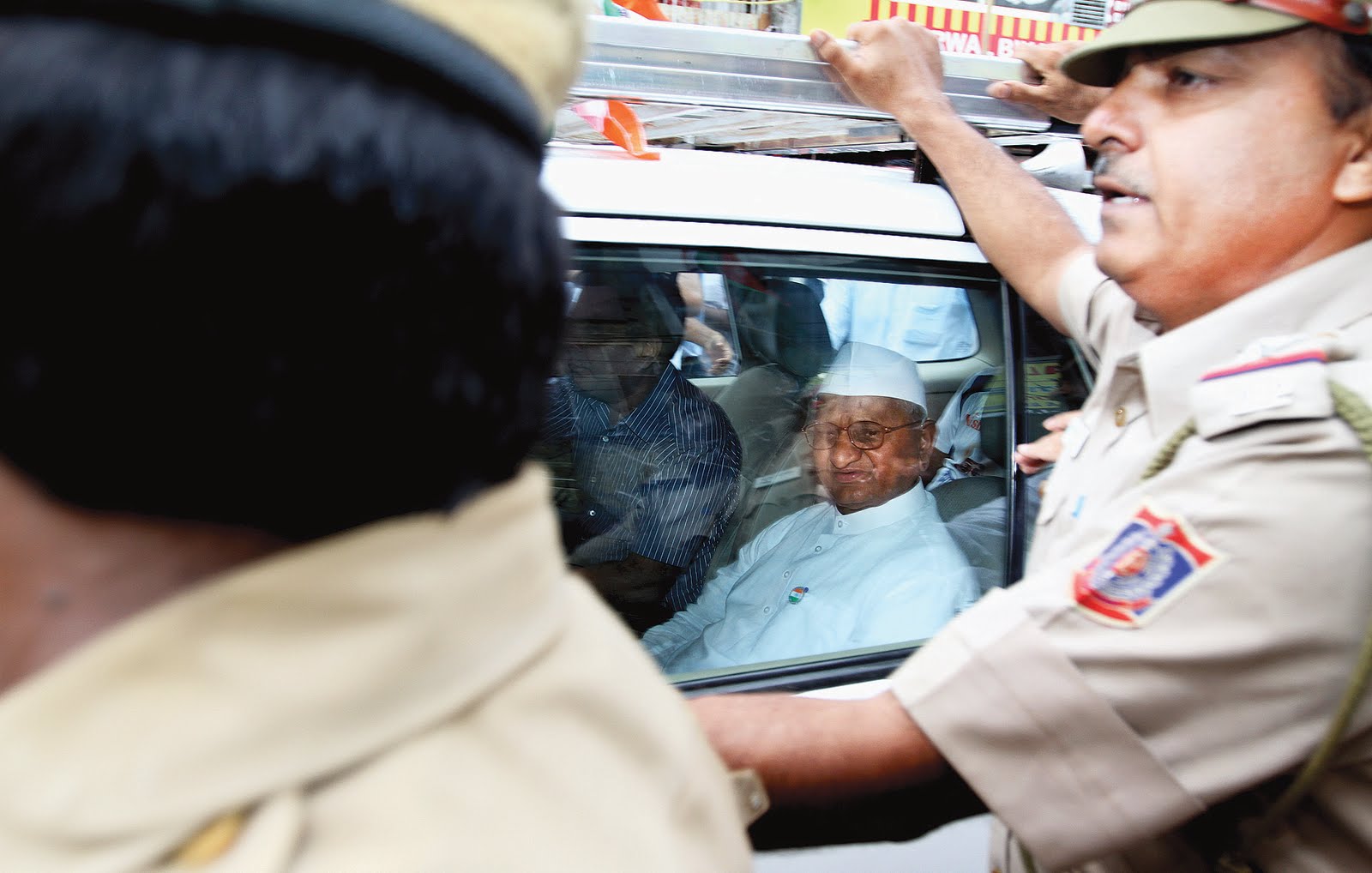
Last week, a bearded sanyasi in a five-metre saffron sarong became the most sought after single in India. He had, a day earlier, turned down the prime minister’s appeal to desist from his satyagraha. Breaking all protocol and ignoring political humiliation, Prime Minister Manmohan Singh directed four of his senior ministers and the cabinet secretary to drive down to Indira Gandhi airport and persuade Baba Ramdev to abandon his indefinite fast against black money—a delegation worthy of greeting a visiting head of state. It was an unprecedented 18 km journey for Finance Minister Pranab Mukherjee, Human Resource Development Minister Kapil Sibal, Tourism Minister Subodh Kant Sahai and Parliamentary Affairs Minister Pawan Bansal accompanied by a retinue of senior officials, including Cabinet Secretary K M Chandrasekar—even German Chancellor Angela Merkel was not given such a welcome. Even Jai Prakash Narayan whose movement led to the ouster of the Congress government in 1977 wasn’t accorded such an honour. Indira Gandhi, the then Prime Minister, just ignored him at her own peril. But Manmohan Singh is not willing to walk that perilous path. The two-and-a-half-hour meeting in the airport lounge between the yoga guru and the Group of Ministers revealed the contours of the power shift in the nation’s ruling echelons. While the Baba dictated and directed the agenda for the discussion, it was clear that those who claim the mandate of the people were utterly helpless in front of a person who had just threatened to start an agitation. The Awesome Foursome of the Congress were forced to establish their credibility and credentials to a Single who had never fought an election. It was a decisive victory of a Single over the Gang of Four.

It wasn’t for the first time that UPA II had lost to a Single. Last month too, the Government panicked and surrendered to Anna Hazare, yet another white dhotiand- Gandhi cap-wearing Single. As he sat on a choreographed hunger strike at New Delhi’s Jantar Mantar, the Government sent ministerial emissaries and finally conceded to Anna’s demand for the appointment of a joint panel to suggest a new draft for a Lokpal Bill. Even at that point of time, the Government created yet another precedent: for the first time since Independence, it involved civil society leaders in drafting a legislation. Former Prime Minister Jawahar Lal Nehru had in the 1950s sought the opinion of other parties and civil society on the Hindu Code Bill, but only after it had been adopted by the Cabinet. From the day the UPA Government constituted the panel, it is Single Hazare and not the ministers who have been setting the pace and nature of the discussion on the proposed Bill.

The rise of both Hazare and Ramdev symbolise the emergence of civil society leaders without clannish or political baggage. Both come from ordinary families and have not studied in elite educational institutions. Still they have acquired national acceptability and credibility by virtue of their work, not just words. The victory of political leaders like J Jayalalithaa, Naveen Patnaik, Mayawati and Mamata Banerjee is also significant as all of them could cut the political Gordian knot because they were not crippled by family considerations or fear of putting their successors in trouble. But none of the above command the widespread social acceptability the Hazare and Ramdev duo does. Though both are fighting for the same cause, they represent an entirely different class and community spectrum. Hazare was catapulted to public prominence by the left-ofcentre upper middle class. When he began his fast, Hazare was visited by Bollywood glitteratti, members of the exclusive chatteratti club from Lutyen’s Delhi as well as a few corporate leaders. Hazare’s team mesmerised the classes and monopolised prime time news. While he nourished his middle class constituency, Hazare ignored people like Ramdev. Since the timing of Hazare’s fast coincided—knowingly or unknowingly—with the Assembly polls, UPA leaders hurriedly cajoled the Gandhian into accepting a 10-member panel to solve the impasse. Hazare didn’t compromise on his basic demands but he did yield to his secular promoters, sparing the political leadership and choosing to attack Gujarat Chief Minister Narendra Modi on corruption—a charge that carries no credibility. But the Government’s reprieve was short-lived.

As the Manmohan administration began its confabulations with Team Hazare, Baba Ramdev took the establishment by surprise by taking on the Government in a manner more organised than his colleague-in-fasting. Not only did he expand the scope of his movement by making black money the central issue, but he also exhorted his followers in 600-odd districts to join. Unlike Hazare, who used social media, the Baba activated his massive following. For the Congress, it was like eating crow. In spite of its contrarian motormouth general secretary Digvijaya Singh constantly attacking Ramdev, the Baba is unperturbed. Obviously neither Singh nor his party are aware of the massive following Ramdev—hailing from a remote Haryana village—has acquired. The Congress made the crippling mistake of considering him just another baba teaching followers how to breathe. But last week, Pranabda and his colleagues realised to their regret that Baba Ramdev could breathe fire as well—one that could easily become a conflagration that may consume this Government. prabhuchawla@newindianexpress.com

Wednesday, April 20, 2011

Power & Politics/The New Indian Express/April 19, 2011

Night of the long knives

Even though the battlelines have not been publicly defined, the knives are clearly out for Hazare’s Hunters. There is nothing unusual about the venomous diatribe being levelled against the man who’s perceived as an outsider, with a mind and mannerisms of his own. Success, of any kind, tends to attract detractors. And this is success of stupendous scale. But what is baffling is the behaviour of the detractors. They have not been able to find any fault in his message. So they’ve chosen to attack Hazare’s fellow messengers. What they seem to have forgotten is that these are not people of his choosing. These are the people who have credible record of taking on the establishment irrespective of its colour.

But the overall objective of their adversaries seems to be to demoralise, defame, tame and eventually maim Team Hazare.

Though the first meeting of the joint government-civil society meeting on the Lokpal Bill ended on a happy note, suspicious smirks were all too visible on the faces of the pro-establishment forces. They seemed to be openly gloating about their (so-far limited) success in defaming some prominent members of the panel.

You don’t need a telescope to spot the elitist vandals who’ve begun mining Hazare’s movements for dirt. If one goes by both the intensity of the attacks and the instruments used for weakening the anti-corruption campaign, the establishment would seem to be playing an invisible hand. Old and mischievous reports are being dug out, illegally-tapped-and-acquired telephone conversations are being circulated, and a communal angle is being touted to discredit Hazare.

Funnily enough, the tirade is being led by leaders of the most fashionable NGOs, their sponsors based in India and abroad and individuals who have been recipients of liberal government patronage and/or funds from either the government or in known entities operating from other countries They have never subjected themselves or their incomes to public scrutiny. But they are ever willing to hold up the magnifying glass for others. So if Hazare puts up a painting of Bharat Mata behind him on his stage, he becomes communal. If he endorses Modi’s Mantra for Development, he is anti-minority. Some people seem to be under the illusion that it’s their presence at Jantar Mantar that made Anna Hazare credible and acceptable.

But then, such reactions are expected from those who spend the morning sitting in dharna, their afternoon at a seminar, evening in a TV studio and weekends in salubrious surroundings. Over conversations with like-minded souls, they make and unmake prime ministers and chief ministers, decide the fate of the world and generally live in a world of their own.

But what is astonishing is the behaviour of the political class. Their grouse against Hazare seems to be that he has taken up a single point agenda. They have a point, but they should have been at the forefront of expanding that agenda. They paralysed Parliament on a JPC for the 2G scam but didn’t stage even a walkout on the Lokpal Bill, which has been pending for 42 years. None of them has made an attempt to strengthen the Lokayukta in his own state. How many chief ministers, ministers or civil servants have been punished by Lokayuktas in this country? Hardly any. Instead, most of them have either been tamed or maimed and made ineffective.

Hazare may not be another Jayaprakash Narayan in the making. JP was a wily strategist who took the political class into confidence and co-opted student leaders as active partners in his Sampoorana Kranti (Total Revolution). But you can’t deny that Hazare has demolished the established social and political order. He is not a creation of Tweeteratti or TVratti. In fact, those two entities got more followers because of him. Some of their members even camped at Jantar Mantar to be seen or to participate in live TV shows.

But now, they are the ones who feel threatened by Hazare. Because he is shaking the system which helped social and corporate oligarchies to make mountains of money and climb up the social, corporate and political ladder. The system ensured that being seen with each other would generate more business and many more opportunities. Debates in Parliament would be followed by cosy dinners at some lobbyist’s residence, with stars from every sector on display. Decisions about who would get what and where would be taken at these rendezvous.

Mumbai may be the financial capital of the country but it’s the drawing rooms of New Delhi which have become parallel South Blocks and North Blocks over the past decade of massive economic growth. A social audit of the membership of elitist dinner clubs will reveal the beneficiaries of the government’s munificence. Millionaires have turned billionaires, directing and dictating the pace and face of economic policies along the way. How else can one explain the frequent changes in policies relating to national highways, telecommunications, civil aviation, car manufacturing and real estate development? And what about the zero tax on the billions made through manipulative trading at stock exchanges? The revenue lost due to tax concessions to the corporate sector amounts to Rs 5 lakh-crore.

Hazare has just won a minor battle. The frequency and fire power of the attacks to come will strongly test his survival skills. Unless, he targets the origin of corruption, the establishment might just get the better of him.

prabhuchawla@newindianexpress.com

Monday, April 18, 2011

Power & Politics / Don't Forget Party Funding Mess/ April 17, 2011

Don’t forget party funding mess

It’s definitely a great victory for a thought germinated by the even-greater Anna Hazare think tank. As legal eagles from both sides ready themselves for a war of words on the framing of the Jan Lokpal Bill, the nation has thrown up another issue for discussion. Even those who actively participated in the debates, televised 24x7, on the well-choreographed happenings at Jantar Mantar are now pointing at the inadequacies in the Hazare argument. The question being raised is: Can a Lokpal institution, however powerful, solve corruption at all levels? A powerful Lokpal may serve as a lethal deterrent for the people who occupy top posts. But can he or she contain the virus that has infected all levels of bureaucracy and political establishment? Hazare and his team haven’t had the time (or inclination?) to track and attack the source of the scourge. The truth is corruption has become an integral part of our political life. It begins at village offices of a political party and ends at its fortress-like headquarters in the state capitals and/ or Delhi. Has anyone of us or any member of the Hazare team raised a question about the source of funds that political parties collect every year? According to conservative estimates, 765 registered political parties—six national, 57 state-level and 702 others—together spend over Rs 25,000 crore on elections every five years. Here’s the math. All the political parties together spend over Rs 50 crore a year to maintain their offices and office-bearers. The Election Commission has fixed a limit of Rs 35 lakh for a Lok Sabha election. But which candidate covers a constituency of over 12 lakh voters and spends only Rs 1 lakh a day? According to Income-Tax sources, each candidate ends up spending over Rs 5 crore on an average. Even if we take four serious candidates for each of the 542 constituencies which go to polls, we are talking about an expenditure of Rs 10,000 crore. Top that with the 15,000-plus candidates who contest 4,500 Assembly seats in the states, with an average expense of Rs 1 crore per candidate, and we’re talking about a total poll expenditure of around Rs 25,000 crore. And the story’s not even done yet. Most of our political leaders have forgotten the contours of the pot-holed roads that crisscross their states, since they travel only by chartered jets or custom-made raths. All national and state-level parties have posh state and central offices running the organisation. Even the district-level officebearer of a ruling party owns a big house and a fleet of cars. All the political parties are bound to file their balance sheets with the Election Commission every year. Most of them do so. But these are balance sheets that would shame even a small-scale entrepreneur. While the truth is that, on an average, both the Congress and BJP spend over Rs 2 crore a month on their offices and office-bearers. So, where does the money come from? The BJP initially decided to collect money through cheques only, but had to give up because people were unwilling to pay that way and party leaders were not ready to change to a more transparent system. The Congress has not even bothered to pretend to cleanse the system. Even the Manmohan Singh Committee, which was appointed by the party in 2003 to suggest how to raise finances for the party, ignored the role of tainted money in politics... In its three-page report, Manmohan skirted the issue of election funding and ended with a high-sounding sentence: “The committee is convinced that the Congress must take the lead in bringing about a new culture of transparency, accountability and integrity in financing.” He conveniently forgot his own report after becoming the prime minister. Sonia Gandhi, who was part of the committee, also forgot to take it forward. The fault doesn’t lie with her or other political leaders. They have become slaves of a system which encourages cash-for-votes for winning an election, and Cabinet notes in exchange for currency for getting the Government policies changed. The past three decades of economic reform have opened new avenues of raising big money by manipulating economic policies so that India’s GDP can grow at 8 to 9 per cent. The rise of crony capitalism and the emergence of a highly powerful coalition of the urban elite, irrespective of their political affiliations, have insulated the decision-making process from scrutiny. The chosen few may fight and shout against each other on TV screens and on the floor of the legislature, but once the cameras are off, they hang out together in the same city or abroad, wining and dining. Real estate tycoon Shahid Balwa is a classic example of a cultural, corporate and political coalition that has total control over the system. Even the beneficiaries of both the CWG scams and Adarsh Society reflect the growing affinity between the rich and mighty. What else could explain the ruling elite’s reluctance to give up the discretionary powers of ministers, chief ministers and other authorities? It is through these powers that the Chavans, Rajas and Kalmadis make their money and use it for winning elections. Unless the business of elections is tackled, valiant fights put up by even hundreds of Hazares will not be able to defeat the coalition of the corrupt.