Showing posts with label Kamal Nath; Rahul Gandhi. Show all posts

Monday, January 2, 2012

DYNASTIC LEADERS IN THE DOCK IN 2012/ The Sunday Standard/January 01, 2012

POWER & POLITICS

Dynastic Leaders in the Dock in 2012: People's Court will decide destiny

If year 2011 was the Year of Nemesis, 2012 will see judgment day for the political dynasties that rule more than half of India. Ever since the rise of regional leaders and the eclipse of nationally acceptable leaders, the Children of a Better God have found a place in what is now turning out to be Dynastic Democracy. Though most of those who control and direct both regional and national politics were born in India’s ruling families, they have also extracted political legitimacy by getting the popular mandate in their own states. As their parents take a backseat, or have unfortunately left the world, GenNext is now trying to assert their own ideologies and identities. From Rahul Gandhi to K Kanimozhi, they will have to now prove their own talents instead of pedigree to become leaders in their own right. During 2012, they will have to prove their utility, acceptability and political desirability not only among their own party cadres, but also among their voters. 2012 is likely to be their Year of Reckoning. The short list.

Rahul Gandhi: The 41-year-old third-generation scion of the Gandhi dynasty has hit the road to justify his privileged ascendency from a mere student to India’s second most powerful political personality after his mother. With just seven years in politics, he has already been declared the next prime minister. Rahul is perhaps aware of the monumental popular expectations from his hidden political skills. He can become prime minister only if he is able to deliver his state to his party. Uttar Pradesh goes to the polls in the first quarter of 2012. March 4, 2012, will decide not only Rahul’s future but also the relevance or irrelevance of dynastic politics. The Congress unfailingly lauds Rahul for the party’s spectacular performance in Uttar Pradesh during the 2009 Lok Sabha elections in which it won 22 seats. Since then, it lost almost all the Assembly by-elections. The Rahul experiment failed in Bihar in 2010; the Congress got only double digits in spite of his nerve-wracking poll campaign. He is not taking any chances in Uttar Pradesh, where he plans to address over 100 election rallies covering almost all the 400 Assembly segments. He has been personally involved in selecting candidates, supervising election material and choosing the campaigners. If his message and medium fails in the state, it will be a huge setback for his future plans. However, if he and his team deliver even 75 seats, Rahul will be unstoppable.

Akhilesh Yadav: The 38-year-old son of former Uttar Pradesh chief minister Mulayam Singh Yadav and president of the Samajawadi Party is posing a bigger challenge to the Gandhi scion than expected. He doesn’t sleep in Dalit homes or indulge in out-of-the-box dramatics. While both Akhilesh and Rahul are targeting Chief Minister Mayawati, the former has the advantage as he is seen as the state’s future chief minister and not as India’s prime minister. Since it is a chief minister that voters elect in the Assembly elections, Akhilesh is better off. Though he has denied any chief ministerial aspirations, he has been on the road for the past six months covering almost every constituency. Unlike his father, Akhilesh is projecting himself as a moderniser and not just a leader out to seek a mandate in the name of caste and religion. He has stayed away from Mulayam’s ideology of forging a political matrimony between Muslims and Yadavs (MY). The 2012 electoral battle will also endorse Akhilesh’s dynastic succession, if he is able to improve SP’s tally of less than 90 seats in the current house.

Sukhbir Badal: With his 84-year-old father and Punjab Chief Minister Parkash Singh Badal looking for an exit, it is now time for Punjab’s 49-year-old Deputy Chief Minister to prove his mettle by returning the state to the ruling Shiromani Akali Dal. For the past six months, he and his wife, Lok Sabha MP Harsimrat Kaur Badal, have been crisscrossing the state seeking a mandate for dynastic succession. Sukhbir’s ascendency led to a minor split in the party. His father, however, has given him full freedom to not only manage the state government but also the party, which rules the state along with the BJP. In the battle between a rich farmer and a glamorous maharaja, Captain Amarinder Singh, Sukhbir’s challenge is not only beating the incumbency factor, but also to carry the entire party along.

K Kanimozhi: For the whole year, M Karunanidhi’s daughter is the toughest task of them all. She has to fight daily not only legal cases, but also family members and the party to retain her political identity. After spending over six months in Tihar Jail as one of the accused in the 2G scam, 2012 is going to be her Year of Survival. Only if she is able to survive her legal nemesis will Kani be able to thrive in the party. With brothers M K Stalin and M Alagiri in deep freeze, thanks to either illness or corruption cases, she has both age and the image of a victim on her side. If Kani is able to come out of her troubles, it is she, and not her feuding siblings, who will be the DMK’s future.

Omar Abdullah: Imposed as the J&K chief minister through a secret midnight family coup in 2008, 42-year-old Omar will face the most serious challenge to his authority when he returns from his Christmas holidays to the frozen Kashmir Valley. 2011 has been a stormy year, both on personal and political fronts. With a section of the Congress and the National Conference baying for his blood, for his failure to ensure proper governance during the past three years, 2012 is going to be his Year of Trial. If Omar fails to strike a balance between good governance and good politics, a huge question mark will be raised against his dynastic succession.

Jagan Mohan Reddy: He failed to pull down the Congress Government in Andhra Pradesh in 2011, but his test ahead is not only to keep his dwindling flock together, but also to project himself as the genuine successor to his father YSR’s legacy, and an effective alternative to both the TDP and the Congress in the state. He won the parliamentary by-election in 2011, but in 2012, he will have to display all his manipulative skills to frustrate the state’s attempt to frame him in myriad corruption cases. Jagan has the money and the muscle power. In 2012, he has to put both to profitable use, and move away from being just a fringe player to the leader of a party who can dictate state politics in the long run.

The Thackeray Cousins:
They have so far remained as only pinpricks in Maharashtra politics. Both Uddhav and Raj Thackeray have been ploughing and plotting for a bigger role, but have failed miserably so far. Both have been flirting and fuming with and against the RSS. In 2011, they couldn’t disturb or dislocate even a cricket match, leave alone the scam-ridden, ineffective Congress state government. Even after three years, the cousins haven’t been able to strike a chord with the cadres or people in the state. Since Maharashtra gets into election mode next year, both will have to establish their utility and relevance to their cadres. 2012 will be their Year of Introspection. If they fail to get the right idea or acceptable ideology in place, both will be doomed as dynastic successors. prabhuchawla@newindianexpress.com

Monday, August 22, 2011

Power & Politics / The Sunday Standard Magazine/ August 21, 2011


No Government, Lost Opposition, but Mera Bharat Mahan

It may sound a trifle absurd, but the person who coined the slogan ‘Mera Bharat Mahaan’ deserves a Noble prize for fiction. For the past few months, each and every institution of good governance has been systematically demolished. The legitimate authority of the state has been compromised. The credibility of the Prime Minister has been eroded, and his personal integrity has come under political scrutiny. The opposition has failed miserably to offer alternative leadership or a credible agenda. Yet, this nation of 1.2 billion people hasn’t lost its collective sanity. Betrayed by the leaders it elected and let down by the institutions it created, Bharat is battling with two crises: non-governance and an isolated leadership. The UPA command is suffering from a pass-the-buck syndrome: the CWG scam is exposed, Suresh Kalmadi gets the blame. When the Government suffers a huge loss of revenue in the 2G licence swindle, A Raja is identified as the villain. And finally when questions are raised about the atrocities perpetrated on Baba Ramdev and Anna Hazare, Delhi Police is the scapegoat.

With the administration changing its strategy on an hourly basis, people are wondering whether the Government itself is an illusion. Who is leading the country? Or running the Government? Prime Minister Manmohan Singh, the AICC president, Rahul Gandhi, an empowered Group of Ministers, civil society leaders or some invisible hand? Something is rotten in the state of India. Its leadership can’t differentiate between the beautiful and the ugly; between what’s good or bad for the country and between the corrupt and the clean. The Government takes one decision in the morning, which is revised by the afternoon and finally reversed by the evening. Funny; no one knows who took what decision.

First, the UPA leadership chose to extend Team Anna a red carpet welcome. In Baba Ramdev’s case, Finance Minister Pranab Mukherjee, accompanied by two colleagues and the cabinet secretary, drove all the way to the airport to woo him. Two days later, the Government unleashed the police on the Baba and spirited him out of the city. He was labelled one of the country’s worst economic offenders. All investigation agencies were activated to open each and every page of his account books. Ramdev was silenced by a slew of administrative bullying that surfaced again when the Hazare tsunami hit the capital.

It was the Prime Minister who first instructed his ministers to open a dialogue with Team Hazare to draft an acceptable Lokpal Bill. A few days later, the same ministers were raising questions about Anna’s integrity because he refused to accept their dictates. A Congress spokesperson even went to the extent of calling Hazare one of the most corrupt persons in the country. Pranabda, one of the saner voices of the UPA, also changed his tune according to the need of the times. On certain occasions, he sounded more authoritarian than some of his other colleagues. With all allies keeping a cryptic yet meaningful silence, various factions of the Congress party were indulging in competitive mudslinging at civil society. There was a visible disconnect between its mouth and its mind. The Congress establishment was spouting views that were totally at variance with the minds of people.

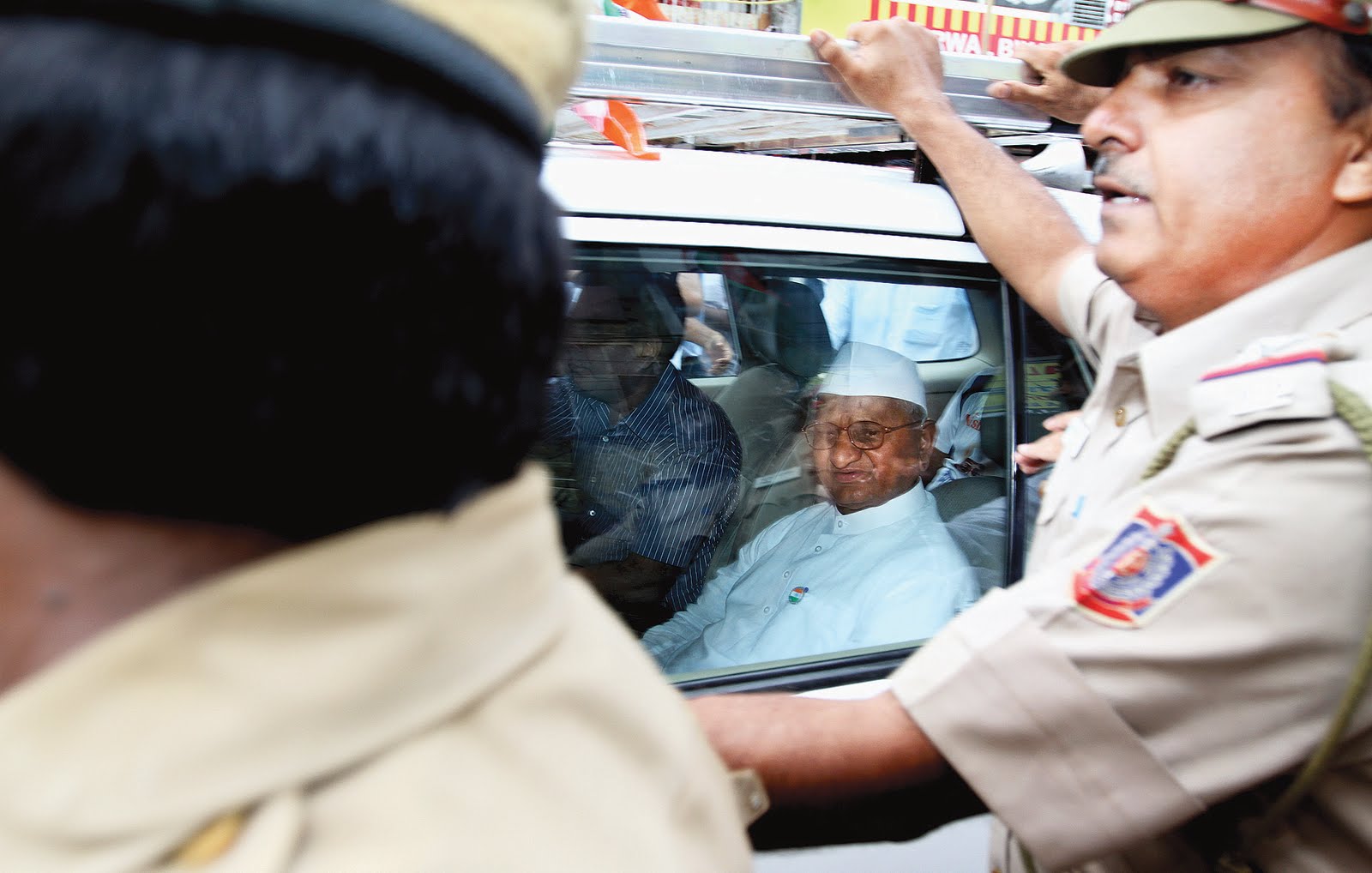
Home Minister P Chidambaram sounded unconvincing when he told the media that it was Delhi Police’s decision to deny Hazare permission to fast and to send him to judicial custody. Technically, the police commissioner and his deputies take independent decisions. But keeping in view the political implications of their actions regarding Hazare, they would have kept their political masters, including the home minister and the Lt. governor, informed of their line of action. Contrary to general perception, the decision to send Anna to a seven-day judicial custody wasn’t taken by a judicial magistrate. It was an assistant commissioner of police who passed the order after Anna refused to give an undertaking for good behaviour. It was a local police inspector who detained Hazare and his followers on the grounds that they were posing a threat to peace. And it is the same police team that withdrew the charges later in the evening, and ordered Anna’s unconditional release.

Imagine. Can a lowly inspector arrest and release India’s tallest civil society leader like Hazare without orders from the top? Since the Prime Minister defended the police action against Hazare, it was evident that Delhi Police was assured of protection from the top. Even the sequence of events that led to the Anna fiasco clearly indicates the absence of cohesive planning to handle civil society’s demands.

The theatre of the absurd concluded with some Congress leaders sending out clear signals that the party had nothing to do with the Government’s decisions. The media was told that Rahul Gandhi is against personal attacks on opponents, and it was he who advised the Government to release Hazare. How come a Government, aided and advised by eminent leaders, couldn’t devise and implement a plan that could prevent the demolition of its only icon—Prime Minister Manmohan Singh? Obviously, Bharat is mightier than India.

prabhuchawla@newindianexpress.com

Tuesday, December 15, 2009

Snippets / Mail Today, December 14, 2009

Kamal Nath keeps a low profile now
QUITE a few of the high- fliers in the UPA government are conspicuous by their absence from the front pages. I don’t know if it is by design or default. One of them is the road transport and highways minister, Kamal Nath. In his earlier avatar as commerce and industry minister, be it New York or London, Berlin or Tokyo, he had been there and done that.
But the man seems to have gone AWOL after moving to Transport Bhavan. Though he was far from pleased with the transfer to transport ministry, he got down to work in right earnest and set ambitious targets for the ministry, which included the construction of an additional 21 km of highways each day. He used his clout to push the Prime Minister’s Office ( PMO) to restructure tender procedures and liberalise norms for funding these projects. He also aggressively pushed the state governments to remove bottlenecks in land acquisition — which has been the bane of the Golden Quadrilateral as well as the National Expressway projects — even as he travelled to world capitals to raise much needed funds for some of his mega schemes. But things just don’t seem to be moving at the pace that he would have wanted.

The sloth that is bureaucracy is not being able to keep up with the pace and style of the new minister. Though new projects covering over 2,000 km have been identified, not many bidders have shown interest due to low returns and long gestation periods. One reason could be that Kamal Nath has not been able to push the National Highways Authority of India because he is still clearing the debris and dirt left behind by his predecessor T. R. Balu.

Kamal’s priority is to put back on track the unfinished projects and then move on to new ones. We will wait and watch whether this long- distance runner will break the record of one of his predecessors, B. C. Khanduri, the retired Major General who was the roads minister during the Vajpayee government.


When official insiders are seen as outsiders
DESPITE the winter chill in Copenhagen, there is much heat being generated in the Indian camp in the Danish capital. Adding to that is the confusion which has more to do with a clash of egos of the many civil servants who were chosen as interlocutors. In keeping with the UPA government’s style of functioning, all of them were seen working as autonomous power centres.
But there was a clear division between those who were formally in the government and those outside that charmed list.

While Jairam Ramesh, the glib environment minister was indulging in letter writings and policy formulations, the prime minister’s special envoy in climate change, the former foreign secretary Shyam Saran, was taking direct orders from the PMO without keeping Ramesh in the loop. But both Ramesh and Saran realised soon that non official interlocutors like Chandrashekhar Dasgupta and Pradipto Ghosh, former environment secretary were no easy pushovers. The two first refused to go Copenhagen in protest against the government adopting a “ flexible” stand on the issue of equitable per capita emissions.

They later agreed to join the delegation after the minister “ cleared the air”. Yet in Copenhagen, they were not fully involved in the behind closed door discussions which Ramesh, Saran, environment secretary Vijay Sharma and Ajai Mathur, head of the bureau of energy efficiency, were conducting. Dasgupta and Ghosh, known for their impeccable credentials and long and credible track record on the issue of climate change, would not budge from the known and stated stand on the emission cuts. They not only refused to join the bandwagon but also have demanded debate and transparency.

And both of them are senior to the other civil servants who make up the Indian team.
Ultimately, it turned out to be a clash between those who were in the government and those who were outside.


THERE is much about Rahul Gandhi that is to be admired. For a couple of years now, we have seen his youthful zest, tenacity and doggedness as he pursues his dream of taking the Congress back to its commanding heights. But if there is one thing that makes me take my hats off, it is his determination to stamp out the culture of sycophancy which has engulfed the Congress since the days of Sanjay Gandhi. Even Indira and Rajiv Gandhi, powerful and charismatic as they were, loved to be surrounded by cronies.

Rita Bahuguna Joshi, the Uttar Pradesh Congress chief showed crony symptoms last week when she gushed to the media in Sitapur, Uttar Pradesh about Rahul Gandhi’s commitment.
" It was so dark. The pilot was not ready to land but Rahul Gandhi forced him to land the helicopter. You should really admire his commitment". Just a day earlier, Beni Prasad Verma, the Samajwadi Party turncoat who is now a Congress MP did his bit of cronyism by calling Atal Bihari Vajpayee unprintable names during a row over the Liberhan Report in Parliament.
On both counts, Rahul set the record straight. He told Rita Joshi that she was neither a pilot nor a weather expert to talk about difficult landings. He brusquely reminded his much senior colleague Verma about parliamentary traditions and etiquette. If sycophants become a vanishing breed in the Congress, praise be to Rahul.